|
|
Product Description
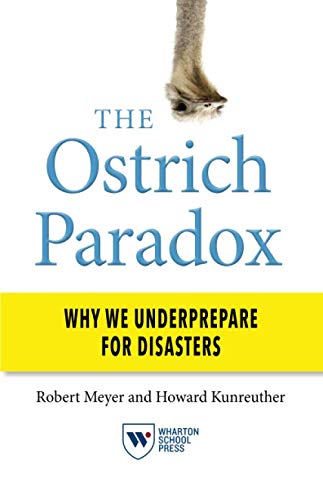
The Ostrich Paradox boldly addresses a key question of our time: Why are we humans so poor at dealing with disastrous risks, and what can we humans do about it? It is a must-read for everyone who cares about risk.”
Daniel Kahneman, winner of the Nobel Prize in Economics and author of Thinking, Fast and Slow
We fail to evacuate when advised. We rebuild in flood zones. We don’t wear helmets. We fail to purchase insurance. We would rather avoid the risk of ”crying wolf” than sound an alarm.
Our ability to foresee and protect against natural catastrophes has never been greater; yet, we consistently fail to heed the warnings and protect ourselves and our communities, with devastating consequences. What explains this contradiction?
In The Ostrich Paradox, Wharton professors Robert Meyer and Howard Kunreuther draw on years of teaching and research to explain why disaster preparedness efforts consistently fall short. Filled with heartbreaking stories of loss and resilience, the book addresses:
Fast-reading and critically important, The Ostrich Paradox is a must-read for anyone who wants to understand why we consistently underprepare for disasters, as well as private and public leaders, planners, and policy-makers who want to build more prepared communities.
Daniel Kahneman, winner of the Nobel Prize in Economics and author of Thinking, Fast and Slow
We fail to evacuate when advised. We rebuild in flood zones. We don’t wear helmets. We fail to purchase insurance. We would rather avoid the risk of ”crying wolf” than sound an alarm.
Our ability to foresee and protect against natural catastrophes has never been greater; yet, we consistently fail to heed the warnings and protect ourselves and our communities, with devastating consequences. What explains this contradiction?
In The Ostrich Paradox, Wharton professors Robert Meyer and Howard Kunreuther draw on years of teaching and research to explain why disaster preparedness efforts consistently fall short. Filled with heartbreaking stories of loss and resilience, the book addresses:
- How people make decisions when confronted with high-consequence, low-probability eventsand how these decisions can go awry
- The 6 biases that lead individuals, communities, and institutions to make grave errors that cost lives
- The Behavioral Risk Audit, a systematic approach for improving preparedness by recognizing these biases and designing strategies that anticipate them
- Why, if we are to be better prepared for disasters, we need to learn to be more like ostriches, not less
Fast-reading and critically important, The Ostrich Paradox is a must-read for anyone who wants to understand why we consistently underprepare for disasters, as well as private and public leaders, planners, and policy-makers who want to build more prepared communities.

Customers Who Bought This Item Also Bought
- Natural Disasters
- The Unthinkable: Who Survives When Disaster Strikes - and Why
- The Social Roots of Risk: Producing Disasters, Promoting Resilience (High Reliability and Crisis Management)
- Risk Communication: A Handbook for Communicating Environmental, Safety, and Health Risks
- Emergency Management
- Counter Terrorism Issues: Case Studies in the Courtroom
- Disaster Policy and Politics; Emergency Management and Homeland Security
- The Starfish and the Spider: The Unstoppable Power of Leaderless Organizations
- Scenario Planning in Organizations: How to Create, Use, and Assess Scenarios
- Hazmat Chemistry Study Guide, 2nd Edition
*If this is not the "The Ostrich Paradox: Why We Underprepare for Disasters" product you were looking for, you can check the other results by clicking this link
 .
Details were last updated on Nov 30, 2025 00:21 +08.
.
Details were last updated on Nov 30, 2025 00:21 +08.