|
|
Product Description
Why our use of language is highly creative yet also constrained
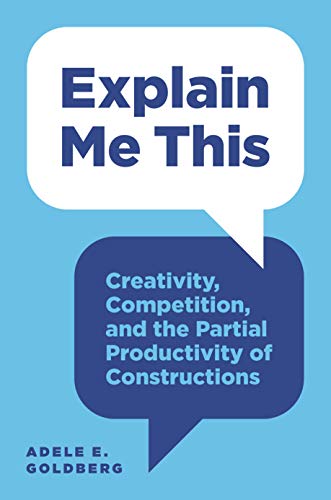
We use words and phrases creatively to express ourselves in ever-changing contexts, readily extending language constructions in new ways. Yet native speakers also implicitly know when a creative and easily interpretable formulation―such as “Explain me this” or “She considered to go”―doesn’t sound quite right. In this incisive book, Adele Goldberg explores how these creative but constrained language skills emerge from a combination of general cognitive mechanisms and experience.
Shedding critical light on an enduring linguistic paradox, Goldberg demonstrates how words and abstract constructions are generalized and constrained in the same ways. When learning language, we record partially abstracted tokens of language within the high-dimensional conceptual space that is used when we speak or listen. Our implicit knowledge of language includes dimensions related to form, function, and social context. At the same time, abstract memory traces of linguistic usage-events cluster together on a subset of dimensions, with overlapping aspects strengthened via repetition. In this way, dynamic categories that correspond to words and abstract constructions emerge from partially overlapping memory traces, and as a result, distinct words and constructions compete with one another each time we select them to express our intended messages.
While much of the research on this puzzle has favored semantic or functional explanations over statistical ones, Goldberg’s approach stresses that both the functional and statistical aspects of constructions emerge from the same learning mechanisms.

Customers Who Bought This Item Also Bought
- The Way We Think
- Usage-Based Approaches to Language Acquisition and Processing: Cognitive and Corpus Investigations of Construction Grammar (Language Learning Monograph)
- Language Unlimited: The Science Behind Our Most Creative Power
- Constructions at Work: The Nature of Generalization in Language
- Spaces, Worlds, and Grammar (Cognitive Theory of Language and Culture Series)
- Constructions: A Construction Grammar Approach to Argument Structure (Cognitive Theory of Language and Culture Series)
- Distant Horizons: Digital Evidence and Literary Change
- Because Internet: Understanding the New Rules of Language
- Construction Grammar and its Application to English (Edinburgh Textbooks on the English Language Advanced EUP)
- Discourse Analysis (Introducing Linguistics)
*If this is not the "Explain Me This: Creativity, Competition, and the Partial Productivity of Constructions" product you were looking for, you can check the other results by clicking this link
 .
Details were last updated on Mar 4, 2026 21:50 +08.
.
Details were last updated on Mar 4, 2026 21:50 +08.