|
|
Product Description
Publisher's Note: Products purchased from Third Party sellers are not guaranteed by the publisher for quality, authenticity, or access to any online entitlements included with the product.
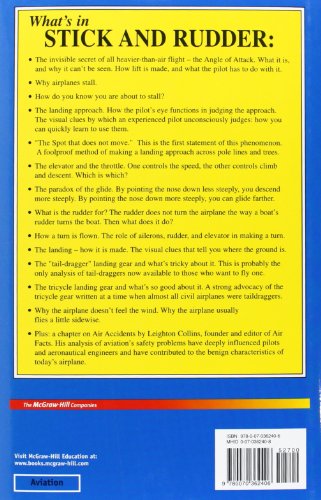
WHAT'S IN STICK AND RUDDER:
- The invisible secret of all heavier-than-air flight: the Angle of Attack. What it is, and why it can't be seen. How lift is made, and what the pilot has to do with it.
- Why airplanes stall How do you know you're about to stall?
- The landing approach. How the pilot's eye functions in judging the approach.
- The visual clues by which an experienced pilot unconsciously judges: how you can quickly learn to use them.
- "The Spot that does not move." This is the first statement of this phenomenon. A foolproof method of making a landing approach across pole lines and trees.
- The elevator and the throttle. One controls the speed, the other controls climb and descent. Which is which?
- The paradox of the glide. By pointing the nose down less steeply, you descend more steeply. By pointing the nose down more steeply, you can glide further.
- What's the rudder for? The rudder does NOT turn the airplane the way a boat's rudder turns the boat. Then what does it do?
- How a turn is flown. The role of ailerons, rudder, and elevator in making a turn.
- The landing--how it's made. The visual clues that tell you where the ground is.
- The "tail-dragger" landing gear and what's tricky about it. This is probably the only analysis of tail-draggers now available to those who want to fly one.
- The tricycle landing gear and what's so good about it. A strong advocacy of the tricycle gear written at a time when almost all civil airplanes were taildraggers.
- Why the airplane doesn't feel the wind.
- Why the airplane usually flies a little sidewise.
- Plus: a chapter on Air Accidents by Leighton Collins, founder and editor of AIR FACTS. His analyses of aviation's safety problems have deeply influenced pilots and aeronautical engineers and have contributed to the benign characteristics of today's airplane.
Stick and Rudder is the first exact analysis of the art of flying ever attempted. It has been continously in print for thirty-three years. It shows precisely what the pilot does when he flies, just how he does it, and why.
Because the basics are largely unchanging, the book therefore is applicable to large airplanes and small, old airplanes and new, and is of interest not only to the learner but also to the accomplished pilot and to the instructor himself.
When Stick and Rudder first came out, some of its contents were considered highly controversial. In recent years its formulations have become widely accepted. Pilots and flight instructors have found that the book works.
Today several excellent manuals offer the pilot accurate and valuable technical information. But Stick and Rudder remains the leading think-book on the art of flying. One thorough reading of it is the equivalent of many hours of practice.
Features
- Deep blue hardcover with dust jacket in colors of ornage, white and blue with
- picture of an airplane.

Customers Who Bought This Item Also Bought
- The Killing Zone, Second Edition: How & Why Pilots Die
- The Compleat Taildragger Pilot
- You Can Be a Pilot!: Answers to 25 Popular Questions About Learning to Fly
- Mike Busch on Engines: What every aircraft owner needs to know about the design, operation, condition monitoring, maintenance and troubleshooting of piston aircraft engines
- The Private Pilot Blueprint
- Weather Flying, Fifth Edition
- Fate Is the Hunter: A Pilot's Memoir
- Pilot's Handbook of Aeronautical Knowledge: FAA-H-8083-25B (FAA Handbooks series)
- Private Pilot Test Prep 2020: Study & Prepare: Pass your test and know what is essential to become a safe, competent pilot from the most trusted source in aviation training (Test Prep Series)
- FAR/AIM 2020: Federal Aviation Regulations/Aeronautical Information Manual (FAR/AIM Series)
*If this is not the "Stick and Rudder: An Explanation of the Art of Flying" product you were looking for, you can check the other results by clicking this link
 .
Details were last updated on Mar 6, 2026 11:02 +08.
.
Details were last updated on Mar 6, 2026 11:02 +08.